


%201.svg)









Why businesses choose us:

What our office moving crews handle:
How we run a business relocation:
Why after-hours suits an office move:
Cargo we move every week:










You should schedule your move date as early as you can. If you’re moving your office locally, at least 1-2 weeks in advance, for long-distance moves, we recommend getting a quote at least 2-4 weeks before your move date.
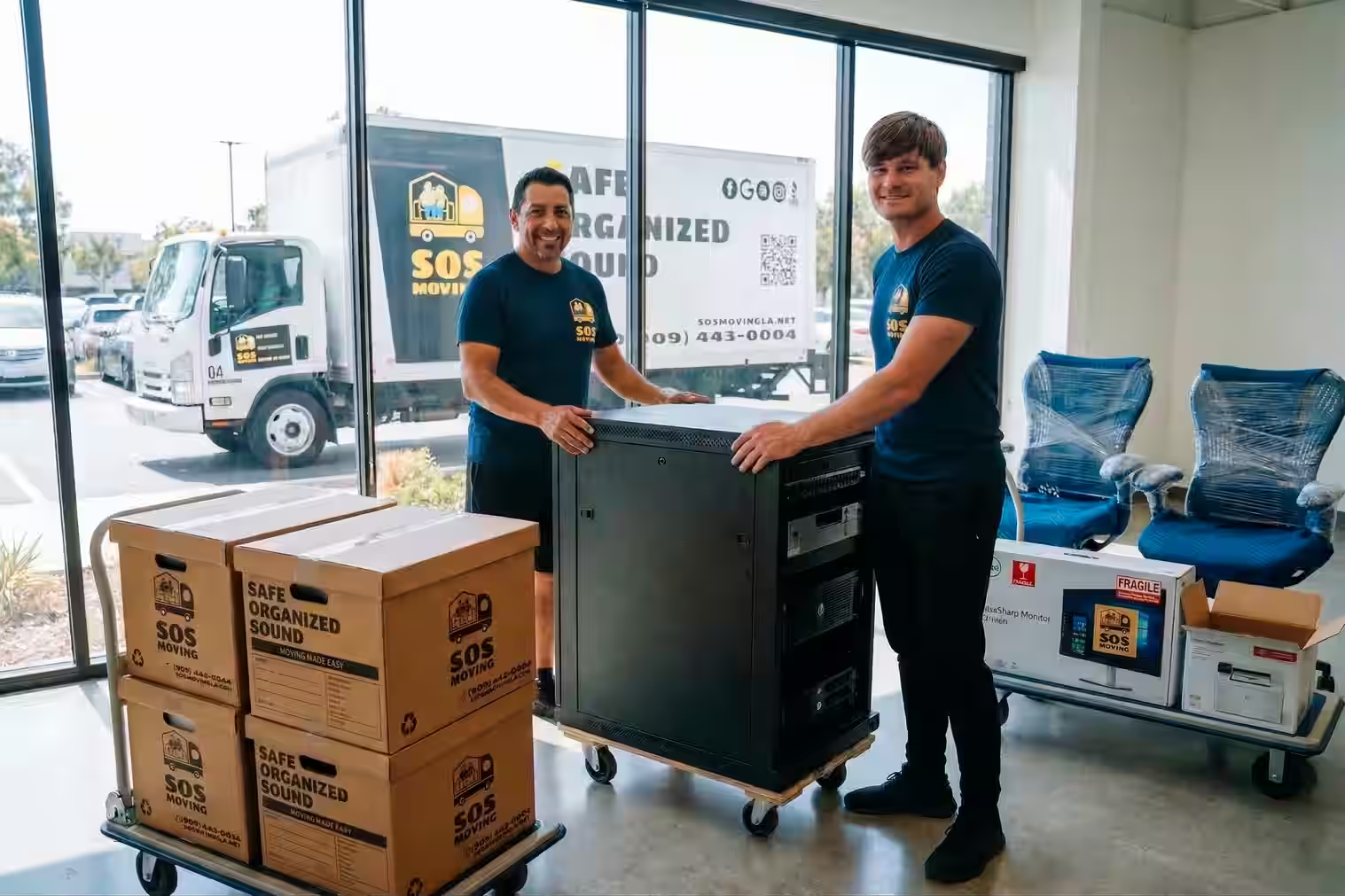
Our team can create a moving plan following your moving needs. We can help pack and unpack your items properly, label boxes, professionally disassemble and reassemble all kinds of commercial equipment, furniture, etc, and load and unload your belongings at your new place.
We recommend starting by making an office relocation plan. Think about how you will relocate your IT and electrical equipment, computers, connections, etc.; furniture, extra items, and other belongings that need to be stored temporarily. Consider disposing of old equipment, unwanted furniture, etc.
Or, you have a better option to do the most important thing: let your customers, service providers, suppliers, banks, and insurance companies know you’re moving, and let our professional team handle the whole relocation ourselves!
Yes, and the service is included in your moving cost. Our team can help disconnect your equipment and computers, pack the wires, etc., and reconnect them when we arrive at your new office. Ask your Moving Coordinator to add the service to your moving estimate.
Office moving starts from $119/hr for a crew and a truck. The final figure depends on the size of the office, floor and elevator access at both buildings, and whether you need packing, cubicle disassembly or IT disconnection and reconnection. We give a firm quote after a walkthrough of your space, so the number you approve is the number you pay.
Yes. Most of our commercial jobs run on a Friday evening, a Saturday or overnight, so your business does not lose a working day. We reserve the freight elevator and the loading dock for the after-hours window with building management, and desks, cubicles and IT equipment are back in place before your team arrives on Monday.
Yes. We are licensed and insured under USDOT 3398018 and issue a certificate of insurance written to the requirements your building sets, with the additional insured wording and coverage limits the property manager asks for, before move day. Send us the COI request as soon as you have a date and we will handle it with building management.
We’ll provide you with a complete list of prohibited items we don’t move, such as toxic substances, fire extinguishers, explosives, etc. You’ll also get a consultation on why movers don’t pack those items and get recommendations on how to transport them.
Yes we’ll dispose of all packing supplies that our company provided.
In a multi-tenant tower, the move date is only half yours. Property management decides when the loading dock and the freight elevator can be booked, how the cab and the corridors must be protected, and what the certificate of insurance has to say before the first cart rolls in. Ask for the written move rules as soon as you have a date, and ask both buildings, because the new landlord's rules apply from the moment the truck backs into its dock.
We issue the certificate of insurance for $50, written to the wording and limits your property manager requests. Send the request with the building's form attached, since a certificate that names the wrong entity can cost you the dock slot.
For a Los Angeles office moving company, the elevator is the real schedule. A freight car booked for a fixed window sets the pace more than the size of the crew does, so the plan starts from the time slots the building gives and fills them with the heaviest loads first: lateral files, copiers, printers and equipment racks. Suites on the same floor as the dock, or in a building with two freight cars, move noticeably faster than the same office on the twentieth floor of a tower with one.
If the new suite is still being built out, confirm the date the landlord hands over the keys before you book the truck. A crew can only unload into a space you are allowed to occupy, and a delayed handover turns a one-day move into a two-day one.
Not every office has a dock, and older street-front buildings load from the curb. Inside city limits, yellow curbs are commercial loading zones, enforced Monday through Saturday from 7AM to 6PM unless the signs say otherwise, and a commercial vehicle may stand there for half an hour to load or unload. Half an hour covers a delivery of a few boxes, not a floor of workstations.
Major streets also carry Anti-Gridlock No Stopping zones that turn the curb lane into a traffic lane during the commute, and the tow-away rule applies from the first minute of the posted hours, with no grace period. Read the signs on your block before booking the start time: a truck that is still loading when the restriction begins has to leave, full or not.
For a longer stay at the curb, temporary no-parking signs are handled by LADOT's Special Traffic Control Division, and the signs have to be up before moving day, so the request belongs early in the plan. The rules above belong to the City of Los Angeles only. Burbank, Glendale, Pasadena, Santa Monica and Long Beach are separate cities with their own permits and posting rules, which is one reason each of them has its own page further down. A move that crosses a city line runs under two rulebooks at once, one at each curb.
Old equipment is where many office moves stall. California treats discarded monitors, computers, printers and phones as universal waste, a class of hazardous waste, and CalRecycle lists them among the items that may not go in the trash. Decide before moving day what goes to an e-waste recycler and what rides on the truck, and tag the equipment accordingly, so nobody has to sort it on the loading dock with the elevator clock running.
File rooms carry a legal duty too. Under California Civil Code 1798.81, a business that gets rid of customer records containing personal information has to shred, erase or otherwise make them unreadable. Purging the cabinets before the move pays twice: the old records are handled the way the law expects, and the crew carries only the files you are keeping. If staff should not spend a workday boxing archives and IT gear, our packing crews can take the file room and the equipment instead.
The furniture that will not fit the new floor plan needs a destination before the move as well. Check the surrender terms of the old lease, since many leases expect the space back empty, and line up resale, donation or disposal for the leftovers, so the last load does not end with a pile of chairs nobody claimed.
Then comes the paperwork that follows a business address. In Los Angeles, the Office of Finance issues an amended Business Tax Registration Certificate once you report the new location, and the change can be filed online. Retailers that hold a California seller's permit update their business location with the CDTFA, through its online services or on the Notice of Business Change form, CDTFA-345.
Our crews work Monday through Sunday, 8AM to 6PM, and a Saturday or Sunday is an ordinary working day for them. That is the simplest way to keep downtime close to zero: employees pack their own desks on Friday afternoon, the crew moves the floor on Saturday, and Sunday is left for IT relocation, the rooms that need a second look and a walk-through before Monday. A same-day move is possible when a crew is free, which helps when a lease date or a flooded suite leaves no time to plan.
A labeled floor plan of the new suite does more for the schedule than an extra mover. When every box, chair and monitor carries a room and a desk number that matches the plan taped at the elevator lobby, the crew places each piece once and nobody hunts for their workstation on Monday. Keep one decision-maker on site on moving day, with the authority to settle questions about what goes where.
Servers and network equipment deserve their own line in the plan. Have your IT provider back up the systems and label every cable and port before shutdown, and be on site when the equipment powers up at the new address; the crew does the disconnecting, padding and lifting, while the configuration stays with your IT team.
For business moving services in Los Angeles, SOS bills by the hour. The rate depends on the size of the crew, the day of the week and how you pay:
| Crew with a truck | Mon–Thu, cash | Mon–Thu, card | Fri–Sun, cash | Fri–Sun, card |
|---|---|---|---|---|
| 2 movers | $119/hr | $129/hr | $135/hr | $145/hr |
| 3 movers | $159/hr | $169/hr | $175/hr | $185/hr |
| 4 movers | $199/hr | $209/hr | $215/hr | $225/hr |
Every job has a 3-hour minimum, or 4 hours when the address is more than 30 miles from our base; overtime starts after 8 hours, and double drive time applies to moves over 10 miles. A $30 fuel charge and a $50 deposit, credited toward the final bill, complete the basic terms.
The weekend premium is easy to read off the table: a crew of three paying cash costs $159 an hour on a Thursday and $175 on a Saturday. Whether that difference is worth it depends on what an idle workday costs your team, which is a number only you know.
Offices bring extras that homes rarely do. Any single item over 300 lbs, such as a heavy safe, is $150 and needs a crew of three. A second truck is $200 when one will not hold the floor, and the certificate of insurance is $50. When a move runs across two days, the load can stay on the truck overnight for $200, and for a longer gap between the old lease and the new one there is storage.
One rule works differently for companies. California's maximum-rate tariff for movers, MAX 4, covers household goods and expressly excludes office and store furniture and equipment, so the tariff's rules on estimates and maximum rates do not govern an office move. Put the scope, the crew, the dates and the price in writing before the first desk moves; a free quote is the place to start.
Many office moves cross a city line, and every crew starts from the same base at 5530 Jillson Street in Los Angeles. The cities below have their own commercial moving pages with their local rules; the distances are from our base, and the times are without traffic.
Up I-5, Glendale is about 15.6 miles and around 22 minutes away, and Burbank, a few exits farther on the same freeway, is about 17.3 miles and around 23 minutes. Both sit well inside 30 miles, so the 3-hour minimum applies.
Pasadena is the closest of the group, about 11.9 miles and around 22 minutes from the base. Long Beach is south on I-710, about 17.5 miles and around 26 minutes, and Santa Monica is the Westside run on I-5 and I-10, about 21.2 miles and around 28 minutes.
In Orange County, the Orange County commercial moving page covers the county as a whole, about 25.4 miles from the base to the civic center in Santa Ana. On I-5, Anaheim is about 19.6 miles, Santa Ana about 25.2 and Tustin about 27.9, so all three stay under the 30-mile line.
Two cities sit past it and carry the 4-hour minimum: Newport Beach, about 37.5 miles by I-5 and SR-55, and Santa Clarita, about 41.5 miles up I-5. To the east, Pomona is about 27.4 miles by SR-60, I-605 and I-10, just inside the line.
SOS Moving runs office and commercial moving projects across the whole LA basin. We move law firms and finance teams out of the high-rise towers of Downtown Los Angeles and Century City, agencies and post-production studios out of the creative lofts of Culver City and Santa Monica, and back-office and studio teams around Burbank, Glendale and Pasadena. South of the airport we handle aerospace, logistics and tech offices in El Segundo, where the warehouse and the office usually have to move on the same weekend.
Every property type sets its own rules, and the plan is built around them. A high-rise tower means a reserved freight elevator, a certificate of insurance filed with the property manager and a crew that works after the building closes for the day. A creative loft often means one slow elevator or an open stairwell, so the schedule follows what the building can actually take rather than what the calendar would prefer. Medical offices need exam furniture, cabinetry and patient records handled carefully and kept in order from the first cart to the last. Warehouses and flex space bring racking, pallets and heavy shop equipment that call for lift gates and machine dollies rather than hand trucks. Our office movers walk both addresses before quoting, so the plan you sign matches your buildings and not a generic checklist.
SOS Moving is a licensed and insured carrier operating under USDOT 3398018, with rates from $119/hr and a 4.9-star review record. Around the move itself we offer packing services for archives, glassware and IT equipment, short and long-term storage for the gap when a new floor is not ready on the day you have to leave the old one, and long distance moving when a business relocation crosses state lines. Send us your target date and a floor plan, and we will build the schedule backwards from the day you need to be open for business again.